
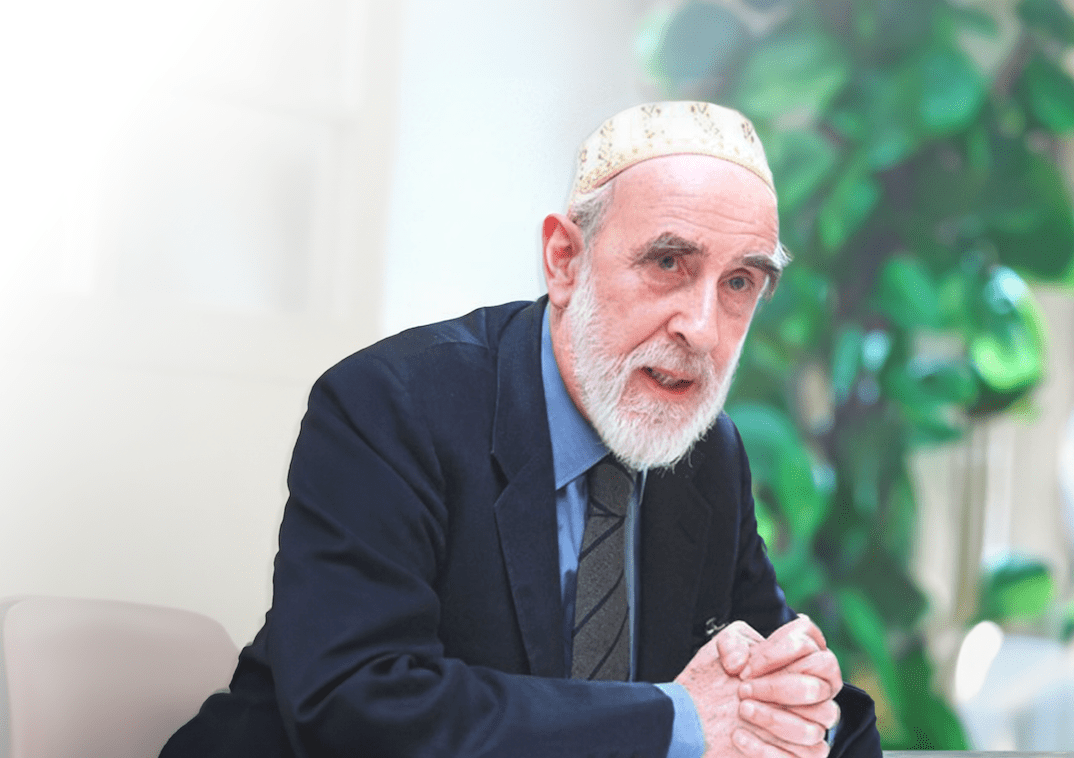
Shaykh Dr. Abdalqadir as-Sufi
1930 – 2021 • Shaykh of Instruction • Founder of the Jumu’a Mosque of Cape Town
“May Allah be pleased with him, shower His mercy upon him, and reward him abundantly for his service to the Ummah.”
A Scottish Mind in Search of God
Born Ian Stewart Dallas in 1930 in Ayr, Scotland, of a Highland family, he was a descendant of the literary critic E.S. Dallas. He studied at the Royal Academy of Dramatic Art and established himself as one of Britain’s most gifted playwrights and television dramatists, adapting works by Charlotte Brontë, Thackeray, Rimbaud, and Lermontov for the BBC.
His staging of an adaptation from Troilus and Cressida gave Albert Finney his first major stage role. In 1963, he appeared in Federico Fellini’s landmark film 8½, playing the role of the mindreader’s partner — a man of European culture at the height of its creative life, and already restless at its heart.
He moved through the “Swinging London” world as an intimate — a close confidant of Edith Piaf, a friend of Eric Clapton, a figure whom the age recognised but could not contain. His inner restlessness pointed him toward something the culture around him could not offer.
The Layla Story
Among his friends in those years was the guitarist Eric Clapton. Dallas gave him a copy of the 12th-century Persian epic Layla and Majnun by Nizami Ganjavi. Clapton, in love with the then-unavailable Pattie Boyd, found in Majnun’s impossible longing a mirror for his own heart, and wrote the iconic song “Layla” (Derek and the Dominos, 1970). A thread of beauty woven by a man still on his way to Allah — before the greater journey had even begun.
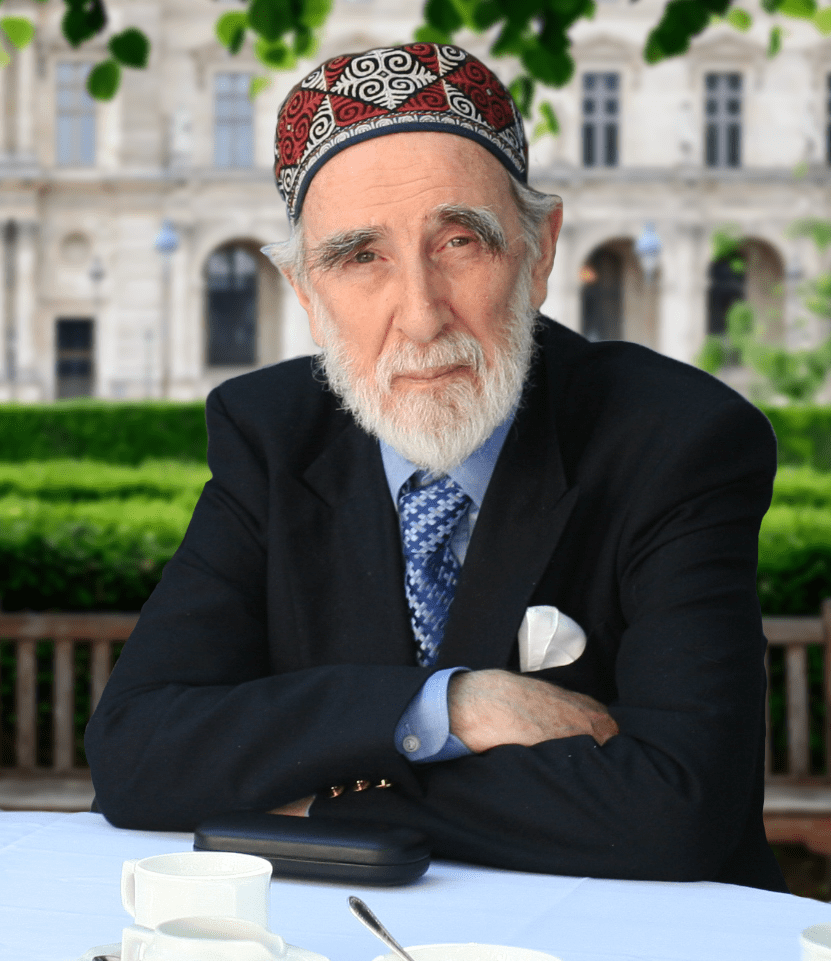
Entry into Islam & The Two Shaykhs
Fez, Morocco, 1967
In 1967, Ian Dallas embraced Islam at the ancient Qarawiyyin Mosque in Fez — one of the oldest centres of learning in the world — witnessed by the Imam Khatib Abdalkarim Daudi and the nationalist leader Alal al-Fasi. He received the name Abdalqadir.
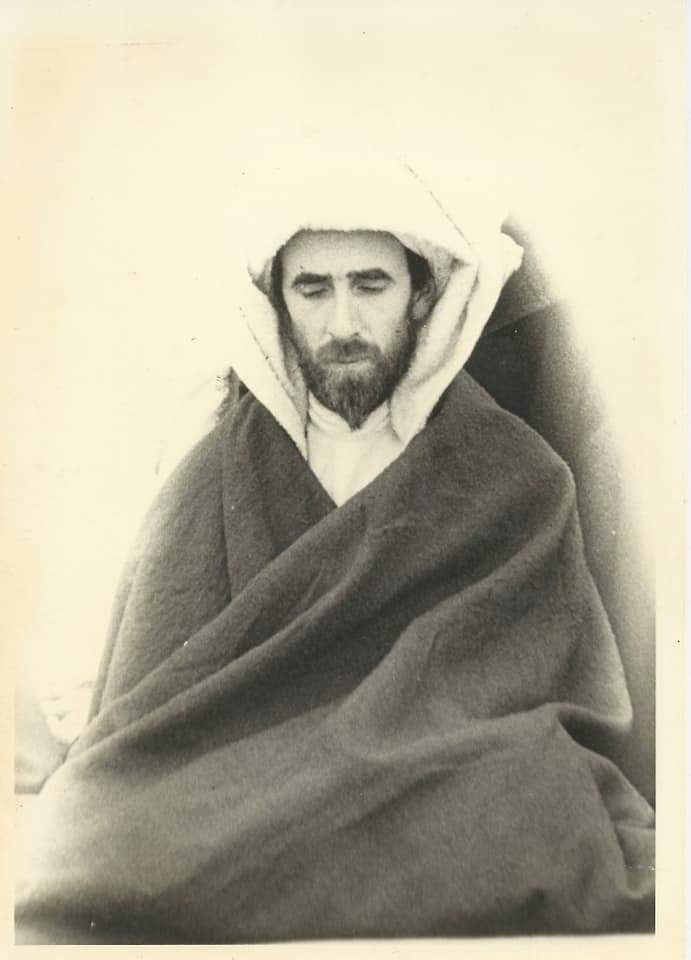
Guided to his first teacher by the grace of Allah, he found Shaykh Muhammad ibn al-Habib of Meknes (1876–1972) — a towering wallī of his age. It was said of this encounter: “Shaykh Muhammad ibn al-Habib turned back on his tracks, and thus he found the seeker.” He joined the Darqawi order as a student, was invested as muqaddam, and given the title as-Sufi. He travelled Morocco and Algeria with his Shaykh, and received further instruction from Sidi Hamud ibn al-Bashir of Blida and Sidi Fudul al-Huwari of Fez.
His second teacher was Shaykh Muhammad al-Fayturi of Benghazi, who — after a period of khalwa (spiritual seclusion) — declared his student’s independence with the words: “No hand is over your hand” — the traditional signal that he was prepared to guide others. His authority was further confirmed by Sidi Muhammad ibn Ali, Moulay Hassan al-Majdhoub, and Sidi Muhammad Bel-Kurshi, establishing the Darqawi-Shadhili-Qadiri Tariqa.
His Spiritual Lineage
First Shaykh:
Shaykh Muhammad ibn al-Habib
Meknes, Morocco (1876–1972)
Second Shaykh:
Shaykh Muhammad al-Fayturi
Benghazi, Libya
Tariqa:
Darqawi-Shadhili-Qadiri
(Habibiyya-Alawiyya lineage)
A Lifetime of Da’wa
Returning to England in 1972 following the passing of Shaykh ibn al-Habib, he established — alongside his companion Shaykh Abdalhaqq Bewley — a Darqawi community modelled on a traditional Moroccan zawiya in Little Venice, London. It drew remarkable souls: scholars, musicians, poets, and seekers from across the Western world.
In 1963 he had acted alongside a then-unknown Bob Dylan in the BBC play Madhouse on Castle Street — one of the last threads of his cultural life before he entered into Islam completely.
In 1982, he delivered landmark discourses in America that became his foundational work Root Islamic Education — returning Muslims to the school of the people of Madinah, the ‘amal of Imam Malik ibn Anas. He then founded the Great Mosque of Granada (Spain) and the Jumu’a Mosque of Cape Town (South Africa), with further communities in Mexico and Germany.
He founded Dallas College, Cape Town (2004), a centre for the formation of Muslim scholars and leaders. His da’wa reached every continent, producing a generation of world-class scholars, translators, and community builders. He has been described as responsible for the most far-reaching and successful Islamic da’wa of the 20th century.
Those He Formed & Those He Touched
A constellation of scholars, artists, and seekers whose lives were shaped by his guidance. While some of these relationships endured for many decades, others were influential primarily in the earlier stages of these individuals’ journeys — each touched in their own way by the light of his teaching.
Shaykh Abdalhaqq Bewley
Scholar & companion from the earliest days
Among the Shaykh’s earliest and most devoted companions, present from the very first days in Morocco and tireless in the service of the da’wa for the rest of his life.
Aisha Bewley
Prolific scholar, translator & author
One of the most prolific translators of classical Islamic texts into English. Under the Shaykh’s direction she produced the authoritative English translation of the Qur’an, the Muwatta of Imam Malik, Ash-Shifa’ of Qadi ʼIyad, the Fusus al-Hikam of Ibn ʼArabi, and many others — a body of work that has made the classical Islamic tradition accessible to generations of English-speaking Muslims worldwide.
Shaykh Hamza Yusuf
Co-founder, Zaytuna College, California
Converted to Islam in 1977 and moved to Norwich to study under the Shaykh. He went on to become one of the foremost Islamic scholars in the Western world and co-founded Zaytuna College — the first accredited Muslim liberal arts college in America.
Prof. Yasin Dutton
Senior Research Fellow, Cambridge Muslim College & Oxford Centre for Islamic Studies • Emeritus Professor, UCT
The foremost academic authority on Maliki fiqh and Madinan ‘amal. His trilogy — The Origins of Islamic Law (1999), Original Islam (2007), and Early Islam in Medina (2022) — is the definitive scholarly articulation of the very tradition the Shaykh spent his life reviving. Currently researching early Shadhili texts at Cambridge and Oxford.
Peter Sanders
World’s pre-eminent photographer of the Muslim world
An iconic 1960s rock photographer — known for portraits of Hendrix, Dylan, and the Rolling Stones — who entered the Shaykh’s London zawiya and embraced Islam in 1971. His life’s work documenting the spiritual world of Islam, including Meetings with Mountains and In the Shade of the Tree, is among the most significant Islamic photographic archives in the world.
Daniel Abdal-Hayy Moore
Beat poet & Sufi lyricist (1940–2016)
Protégé of Allen Ginsberg and Lawrence Ferlinghetti; founder of the Floating Lotus Magic Opera Company in Berkeley. He met the Shaykh in 1970 and entered Islam through the Habibiyya tariqa. He became one of the great English-language voices of Islamic spiritual poetry, his verse spanning five decades of devotion and luminous inner exploration.
The Cape Town Years & Legacy
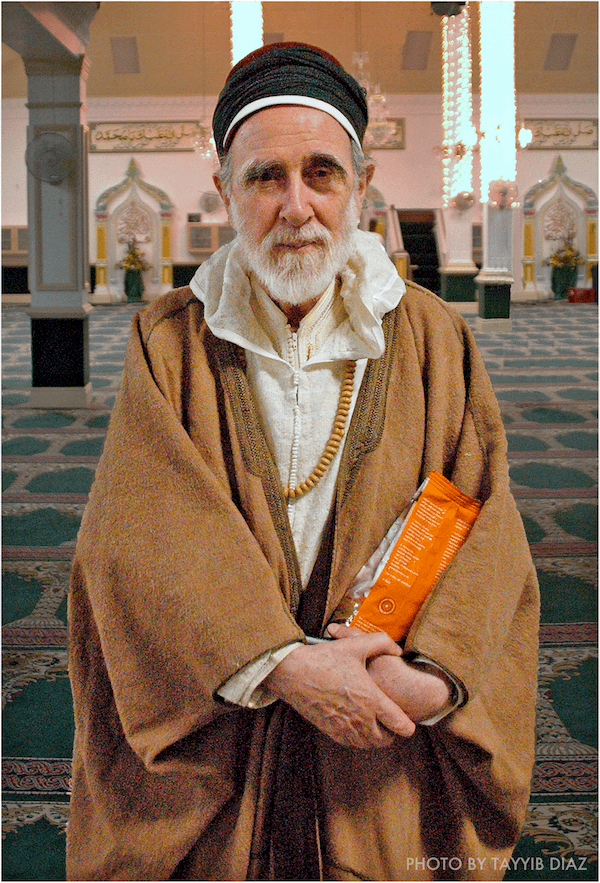
In 2002, the Shaykh relocated to Cape Town — the city where this mosque stands, and where his presence brought a new depth to the community he had founded. He continued writing, teaching, and guiding his worldwide tariqa without pause. He was uncompromising in his insistence that Islam is a complete way of life — inward and outward, spiritual and political, personal and communal — and that its revival required not reform but return to the pristine pattern of the people of Madinah.
Shaykh Dr. Abdalqadir as-Sufi passed from this world on 1 August 2021 in Cape Town, aged 90, may Allah be pleased with him. He is buried in the city where the Jumu’a Mosque stands as his living legacy — a community of practice, a place of prayer, and a point of light in the Mother City.
The Dallas Foundation was established before his passing to preserve and perpetuate his legacy, making his many works and discourses available to the widest possible audience.
For his complete works, discourses, and archive, visit shaykhabdalqadir.com
Works & Writings
Over twenty books spanning Islamic jurisprudence, Sufism, political theory, literary criticism, and drama
A — Core Islamic, Sufi & Political Works
- The Way of Muhammad (1975) — existential exposition of Islam rooted in Tasawwuf
- Indications From Signs (1980) — aphoristic metaphysical reflections
- Qur’anic Tawhid (1981) — divine unity against modern fragmentation
- Letter to an African Muslim (1981) — anti-colonial Islamic address
- Kufr — An Islamic Critique (1982) — disbelief as a civilisational system
- Root Islamic Education (1982) — Madinan fiqh and the school of Imam Malik
- The Sign of the Sword (1984) — classical fiqh against modern finance capitalism
- The Return of the Khalifate (1996) — Ottoman decline and political restoration
- The Technique of the Coup de Banque (2000) — banking, sovereignty, and usury
- Sultaniyya (2002) — comprehensive Islamic political theory
- The Muslim Prince (2009) — leadership ethics and governance in Islam
C — Artistic Works
- Three Plays (2010) — dramatic works exploring authority, myth, and identity
- Ten Symphonies of Gorka König (2010) — libretto-philosophical musical collaboration
B — Literary, Philosophical & Cultural Works
- The Book of Strangers (1972) — alienation and metaphysical homelessness
- Oedipus and Dionysus (1992) — tragedy, myth, and Western psychological collapse
- The New Wagnerian (2001) — music, myth, and post-Christian Europe
- The Time of the Bedouin (2007) — nomadism as spiritual and political metaphor
- The Interim Is Mine (2010) — civilisational interregnum and authority vacuum
- The Engines of the Broken World (2012) — industrial modernity as metaphysical catastrophe
- The Entire City (2021) — final synthesis of urbanism, power, and meaning
D — Translations Undertaken by His Students
Not authored by him, but initiated, supervised, and inspired by his vision — among the most lasting fruits of his da’wa.
- The Noble Qur’an: A New Rendering — Abdalhaqq & Aisha Bewley
- The Muwatta of Imam Malik — Aisha Bewley & Ya‘qub Johnson
- Ash-Shifa’ (Muhammad: Messenger of Allah) — Qadi ‘Iyad, trans. Aisha Bewley
- The Darqawi Way — letters of al-Darqawi, trans. Aisha Bewley
- Fusus al-Hikam (The Seals of Wisdom) — Ibn ‘Arabi, trans. Aisha Bewley